


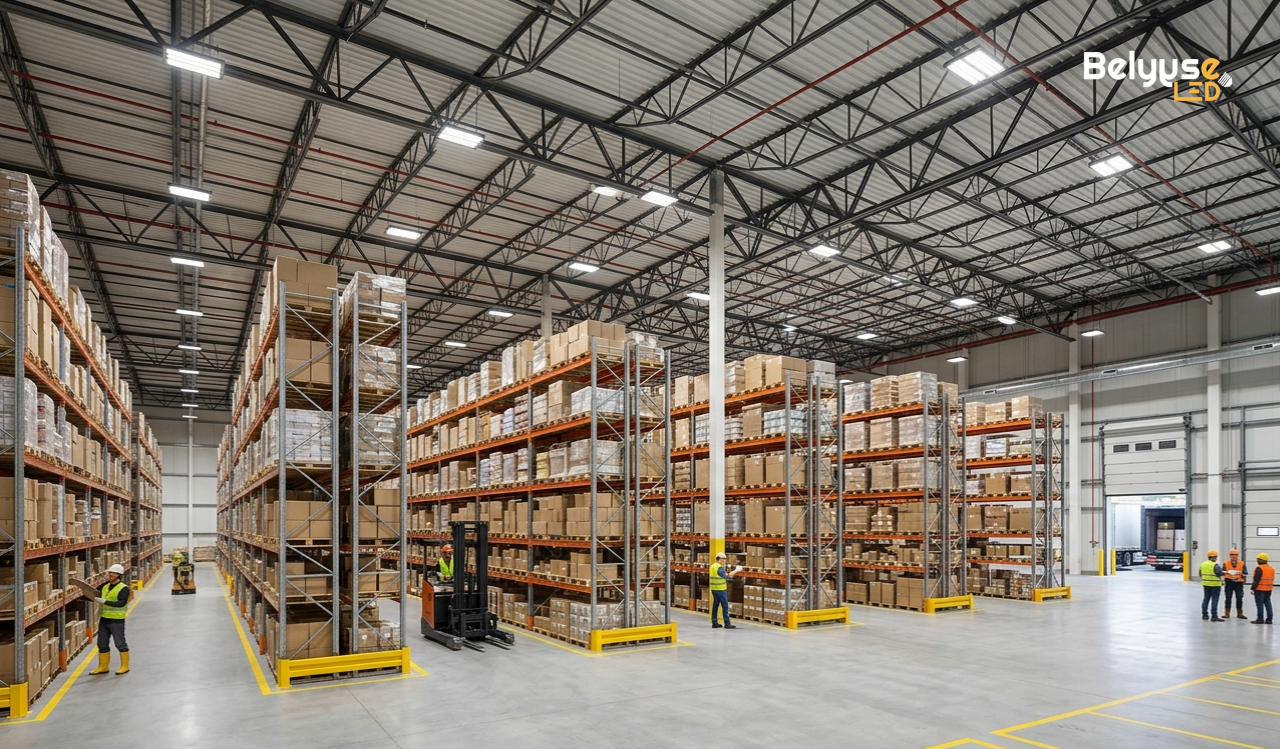
A warehouse is more than a large space filled with racks and products. It is a working environment where visibility, safety, productivity, and energy efficiency directly affect daily operations.
Poor warehouse lighting can create dark spots, glare, shadows, and visibility problems around racks, aisles, loading areas, and workstations. On the other hand, a properly planned warehouse lighting design can improve visibility, reduce energy consumption, increase safety, and create a more productive working environment.
For architects, constructors, contractors, and interior designers, lighting should therefore be considered during the planning stage—not as an afterthought.
In this guide, we will explain how to choose the right LED warehouse lighting, high bay lights, lux levels, beam angles, lighting layouts, and energy-efficient lighting solutions.
What Is Warehouse Lighting?
Warehouse lighting refers to the complete lighting system used to illuminate storage facilities, distribution centers, logistics spaces, industrial warehouses, loading areas, aisles, packing zones, and other large commercial spaces.
A good warehouse lighting system should provide:
- Adequate illumination
- Uniform light distribution
- Low glare
- Minimal shadows
- High energy efficiency
- Long operating life
- Easy maintenance
- Appropriate IP protection
- Safe working conditions
The goal is not simply to make the warehouse bright.
The goal is to put the right amount of light in the right place.
Why Is Proper Warehouse Lighting Important?
Warehouse lighting has a direct impact on worker safety, productivity, operational efficiency, and energy costs.
1. Improves Workplace Safety
Warehouses often have forklifts, moving equipment, tall racks, loading areas, and busy walkways.
Insufficient illumination can make it difficult to identify obstacles, read labels, see floor markings, or notice hazards.
Properly designed lighting improves visibility and helps create a safer working environment.
2. Improves Picking & Inventory Accuracy
Warehouse employees need to clearly read product labels, barcodes, packaging information, and inventory numbers.
Lighting should therefore illuminate not only the floor but also the vertical surfaces of storage racks.
This is especially important in high-rack warehouses where a floor-level lighting calculation alone may not provide sufficient visibility.
3. Reduces Energy Consumption
Warehouses can operate for long hours, making lighting a major part of operational energy use.
Replacing older lighting systems with energy-efficient LED warehouse lights can significantly reduce electricity consumption and maintenance requirements. Some current industry guides report energy reductions of roughly 50–70% compared with older HID technologies, although actual savings depend on the existing system, operating hours, and controls.
4. Reduces Maintenance
Many warehouses have high ceilings, making lamp replacement difficult and expensive.
Long-life LED lighting reduces the frequency of replacement and maintenance work.
This is particularly valuable for facilities operating continuously or where access to lighting fixtures requires lifting equipment.
Understanding Lux Levels for Warehouse Lighting
One of the most important aspects of warehouse lighting design is selecting the correct illuminance level.
Lux measures the amount of light reaching a surface.
Different warehouse activities require different illumination levels. For example, general storage does not require the same lighting as detailed inspection or packing.
Typical design references place general storage around 100–200 lux, picking areas around 200–300 lux, and more detailed work at significantly higher levels. Exact requirements should always be checked against the applicable local standards and project specifications.
Important: These values should be treated as design guidance rather than universal legal requirements. Architects and lighting designers should verify the applicable standards for the project's location and use.
Choose the Right Warehouse Lighting Fixture
There is no single lighting fixture that is perfect for every warehouse.
The right solution depends on:
- Ceiling height
- Rack height
- Aisle width
- Required lux level
- Warehouse activity
- Mounting position
- Beam angle
- Dust and moisture exposure
- Operating hours
- Maintenance requirements
Here are some of the most common options.
1. LED High Bay Lights
LED high bay lighting is one of the most popular solutions for warehouses with high ceilings.
High bay fixtures are designed to deliver high lumen output from elevated mounting heights.
They are suitable for:
- Large warehouses
- Distribution centers
- Industrial facilities
- Manufacturing areas
- Logistics centers
- High-rack storage
UFO high bays are particularly useful for open areas, while linear high bays can be advantageous in aisle-oriented layouts.
2. Linear High Bay Lighting
Linear LED high bay lights are particularly useful for warehouses with long aisles and organized rack layouts.
Their elongated design can provide a more suitable distribution along aisles and work areas.
For rack-based warehouses, fixture positioning should be planned around the aisle and rack geometry, rather than simply placing lights in a regular ceiling grid.
3. LED Low Bay Lighting
Low bay lighting is generally used where ceiling heights are lower.
Using an excessively powerful high bay fixture in a lower space can create unnecessary glare and energy consumption.
The lighting designer should select the fixture according to the actual mounting height and required illumination.
How Ceiling Height Affects Warehouse Lighting
Ceiling height is one of the most important factors when selecting an LED high bay.
As mounting height increases, the lighting designer must consider:
- Lumen output
- Beam angle
- Optics
- Fixture spacing
- Mounting position
- Uniformity
- Glare
For example, a fixture designed for a 6-metre ceiling may not provide the same performance when installed at 12 metres.
Therefore, do not select warehouse lights based only on wattage.
Instead, evaluate:
Lumens + mounting height + beam angle + lux + uniformity.
This produces a much more reliable lighting design.
Beam Angle Matters More Than You Think
Beam angle determines how widely light spreads across the warehouse.
Wide Beam
Useful for:
- Open storage areas
- Lower ceilings
- Large unobstructed spaces
Medium Beam
Useful for:
- General warehouse areas
- Moderate ceiling heights
- Organized storage layouts
Narrow Beam
Useful for:
- High ceilings
- Tall racks
- Narrow aisles
- Areas requiring concentrated illumination
The wrong beam angle can result in either excessive overlap or dark areas.
That is why photometric lighting calculations are highly valuable before installation.
Warehouse Lighting Layout: Don't Just Light the Floor
A common mistake in warehouse projects is designing lighting only according to the floor area.
But warehouse workers interact with:
- Rack labels
- Product boxes
- Barcodes
- Shelving
- Machinery
- Workstations
Therefore, lighting should be designed around the actual tasks being performed.
For rack aisles, placing fixtures strategically above or along aisles can improve illumination on rack faces and reduce unnecessary light falling on areas that do not need it.
A good warehouse lighting layout should minimize:
- Dark spots
- Excessive shadows
- Glare
- Uneven illumination
- Light wastage
- Difficult maintenance access
IP Rating for Warehouse Lights
Warehouse environments can contain dust, moisture, chemicals, heat, or cleaning water.
This makes the IP rating of LED warehouse lights an important consideration.
For example, an IP65-rated fixture provides protection against dust ingress and water jets from specified directions.
However, the correct IP rating should always be selected according to the actual environmental conditions.
Consider higher protection where the environment involves:
- Dust
- Moisture
- Washdown
- Outdoor exposure
- Industrial contaminants
- High humidity
Do not select an IP rating simply because it is higher.
Select it according to the real conditions of the project.
Choose the Right Color Temperature
Color temperature can influence visibility and the overall working environment.
For many warehouses, neutral to cool white lighting is commonly considered because it provides a clear, functional appearance. Current warehouse lighting guidance frequently references 4000K–5000K as common choices.
4000K
A balanced option for:
- General warehouses
- Storage
- Commercial facilities
- Mixed-use industrial spaces
5000K
Can be suitable for:
- High-visibility work areas
- Detailed warehouse tasks
- Inspection zones
- Industrial environments
The final choice should consider the visual task, surrounding finishes, user comfort, and the project's lighting specification.
Don't Ignore CRI
CRI (Color Rendering Index) describes how accurately a light source reveals colors compared with a reference source.
For general storage, moderate CRI may be sufficient.
However, areas involving:
- Product inspection
- Quality control
- Color-sensitive products
- Manufacturing
- Detailed visual tasks
may benefit from higher CRI lighting.
For architects and interior designers, this becomes especially important when the warehouse includes product display, showroom, inspection, or customer-facing areas.
Smart Warehouse Lighting Can Save More Energy
LED technology already improves efficiency, but smart lighting controls can take warehouse energy management further.
Consider:
Motion Sensors
Lights automatically increase output when workers or vehicles enter an area.
Occupancy Sensors
Lights can be reduced when areas are unoccupied.
Daylight Harvesting
In warehouses with skylights or windows, lighting output can be adjusted according to available natural light.
Dimming
Different warehouse zones can operate at different lighting levels depending on activity.
Industry guidance indicates that occupancy-based controls can produce substantial additional savings, but actual performance depends on warehouse usage and control strategy.
Emergency Lighting Should Be Part of the Design
Warehouse lighting is not only about normal working conditions.
Emergency lighting and illuminated escape routes should be considered during the overall electrical and lighting design process.
Emergency lighting helps occupants safely navigate the facility during power failures or other emergencies.
Architects, electrical consultants, and contractors should coordinate emergency lighting with the applicable local fire and building regulations.
Common Warehouse Lighting Mistakes
Mistake 1: Choosing Lights Only by Wattage
A 150W light from one manufacturer may produce very different results from a 150W light from another.
Look at lumens and photometric performance—not wattage alone.
Mistake 2: Ignoring Ceiling Height
The same fixture cannot automatically be used at every mounting height.
Mistake 3: Creating Dark Aisles
Rack layouts should be considered before finalizing fixture positions.
Mistake 4: Overlighting the Entire Warehouse
Lighting every zone to the highest required level increases energy consumption unnecessarily.
Mistake 5: Ignoring Glare
High-output fixtures can create uncomfortable glare if optics and mounting positions are poorly selected.
Mistake 6: Forgetting Maintenance
A fixture may perform well on paper but become difficult to maintain when installed 12–15 metres above the floor.
Maintenance access should be considered during the design stage.
Why Photometric Lighting Design Is Important
Before installing warehouse lights, a professional lighting simulation can help determine:
Number of fixtures
- Fixture positions
- Lux levels
- Uniformity
- Beam angles
- Mounting height
- Potential dark spots
- Potential overlighting
- Estimated energy consumption
Tools such as DIALux or other photometric software allow designers to test the proposed lighting arrangement before installation. This is especially useful for architects, contractors, and interior designers because lighting decisions can be evaluated before expensive site changes are required.
Warehouse Lighting Checklist for Architects & Contractors
Before finalizing a warehouse lighting project, check:
☑ What is the ceiling height?
☑ What are the rack heights?
☑ What activities take place in each zone?
☑ What lux level is required?
☑ Is illumination uniform?
☑ Are rack faces adequately illuminated?
☑ Is glare controlled?
☑ Is the beam angle suitable?
☑ Is the IP rating appropriate?
☑ Is the color temperature suitable?
☑ Is the CRI appropriate for the task?
☑ Can motion or occupancy sensors be used?
☑ Is emergency lighting included?
☑ Is maintenance access practical?
☑ Has a photometric simulation been completed?
Final Thoughts
A successful warehouse lighting design is not simply about installing more powerful lights.
It is about creating the right balance between safety, visibility, energy efficiency, comfort, productivity, and maintenance.
For architects, constructors, contractors, and interior designers, the best approach is to plan lighting alongside the warehouse's architecture, rack arrangement, electrical system, and operational requirements. With the right combination of LED high bay lights, appropriate lux levels, beam angles, efficient lighting layouts, smart controls, and professional lighting simulation, warehouses can achieve better visibility while reducing unnecessary energy and maintenance costs.
The right lighting doesn't just illuminate a warehous-it makes the entire operation work better.